Pennsylvania slang is a mix of regional words and phrases unique to different parts of the state like “yinz” (you all) in Pittsburgh, “jawn” (a thing) in Philadelphia, and “crick” (creek) almost everywhere else. Each region has its own flavor, shaped by immigration history, geography, and local pride.
Key Takeaways
- Pennsylvania doesn’t have one single slang it has several regional dialects, mainly Western PA (Pittsburghese), Eastern PA (Philly), and Pennsylvania Dutch Country
- “Yinz” comes from Pittsburgh and means “you all”; “jawn” comes from Philadelphia and can mean almost any noun
- Much of the state’s older slang traces back to Scots Irish and German immigrant speech patterns from the 1700s and 1800s
- These words are still used today, though usage is heavier among older and lifelong residents than transplants
- The tone is almost always friendly, informal, and tied to local identity rather than any insult
- Merchandise, sports culture, and social media have kept many of these terms alive and even made them trendy again
People search for Pennsylvania slang for a few simple reasons. Maybe they heard a Pittsburgh coworker say “yinz” and had no idea what it meant.
Maybe they watched a video where someone from Philly kept saying “jawn” about five different things. Or maybe they’re planning a trip to the state and want to understand the locals a little better.
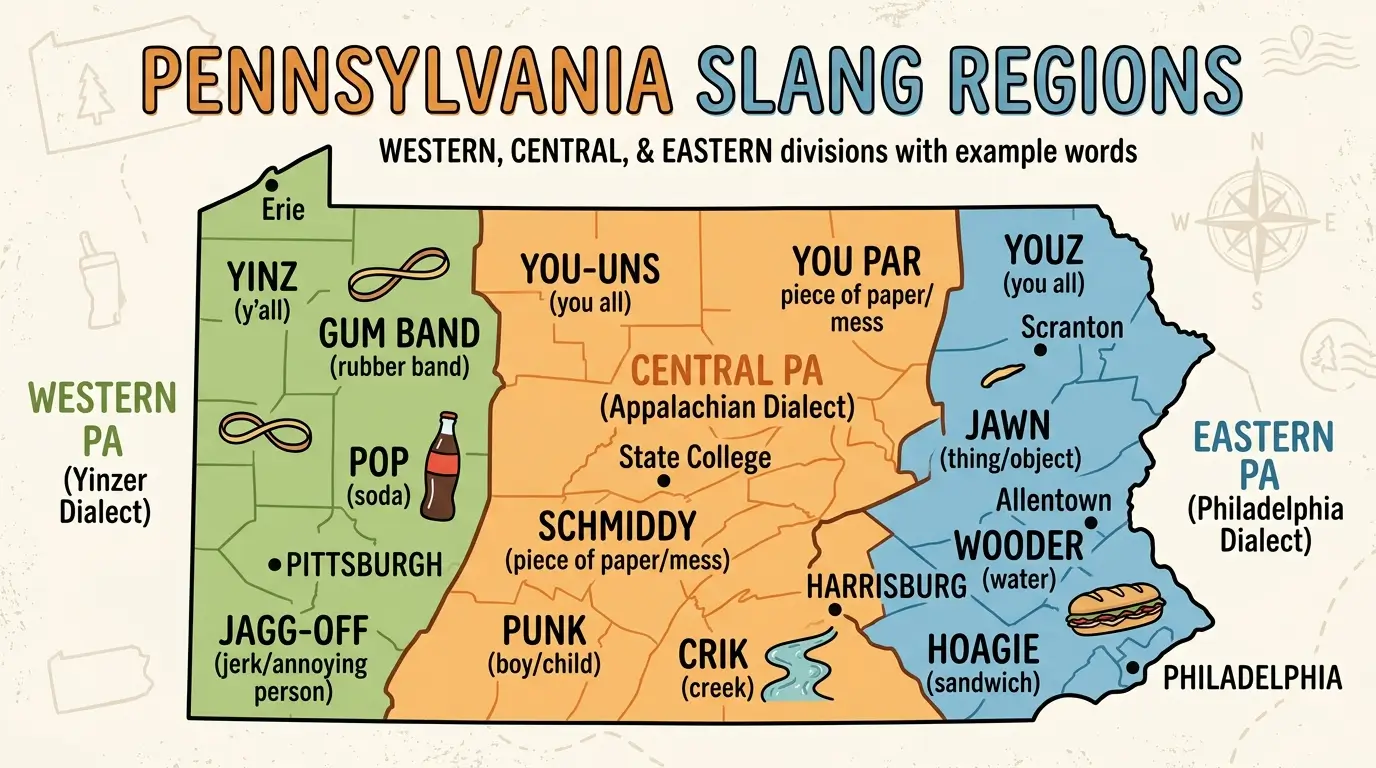
Pennsylvania is a strange case in American dialect maps. It’s not one region it’s three or four squeezed into one state.
Pittsburgh in the west sounds nothing like Philadelphia in the east, and both sound different from the small towns of Pennsylvania Dutch Country in the middle. That’s why “Pennsylvania slang” isn’t really a single list of words. It’s a patchwork.
What Does Pennsylvania Slang Mean?
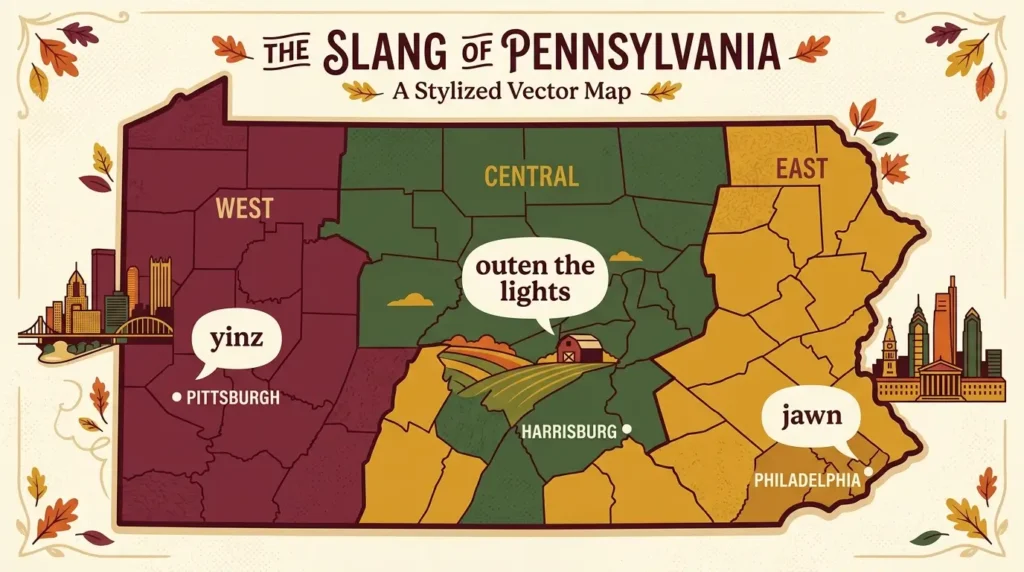
Pennsylvania slang refers to the collection of informal words and phrases used across the state, and it changes a lot depending on which part of Pennsylvania you’re in.
There isn’t one “Pennsylvania accent” there are several, each shaped by different waves of immigration and geography.
In Western Pennsylvania, especially Pittsburgh, the dialect is nicknamed “Pittsburghese.” Words like “yinz,” “n’at,” and “redd up” fall into this category.
In Eastern Pennsylvania, especially Philadelphia, the slang leans more urban and East Coast, with words like “jawn” and “wooder” (water) standing out.
In the central and southeastern parts of the state, Pennsylvania Dutch Country adds its own flavor, with phrases like “outen the lights” that come directly from German sentence patterns.
For example, a Pittsburgh resident might say, “Yinz wanna go dahntahn?” while a Philadelphia resident might say, “Grab that jawn off the table.” Both are Pennsylvania slang, but they’d sound like two different languages to an outsider.
Quick Meaning Box
| Meaning | Simple Explanation |
| Yinz | “You all” used mainly around Pittsburgh |
| Jawn | A stand in word for almost any person, place, or thing used mainly around Philadelphia |
| Crick | The way many Pennsylvanians pronounce “creek” |
| N’at | Added to the end of a sentence to mean “and so on” |
| Redd up | To clean or tidy up a space |
| Wooder | The Philadelphia area pronunciation of “water” |
Pronunciation
Most Pennsylvania slang words are pronounced close to how they’re spelled, but a few trip people up. “Yinz” rhymes with “hinz,” like the first part of “Heinz.” “Jawn” rhymes with “lawn” or “dawn.
” “Crick” rhymes with “trick,” not “creek.” “Wooder” sounds close to “wooder,” with the “a” in water swapped for an “oo” sound. Getting these right is part of the fun mispronouncing them is usually what gives an outsider away.
Where Does Pennsylvania Slang Come From?
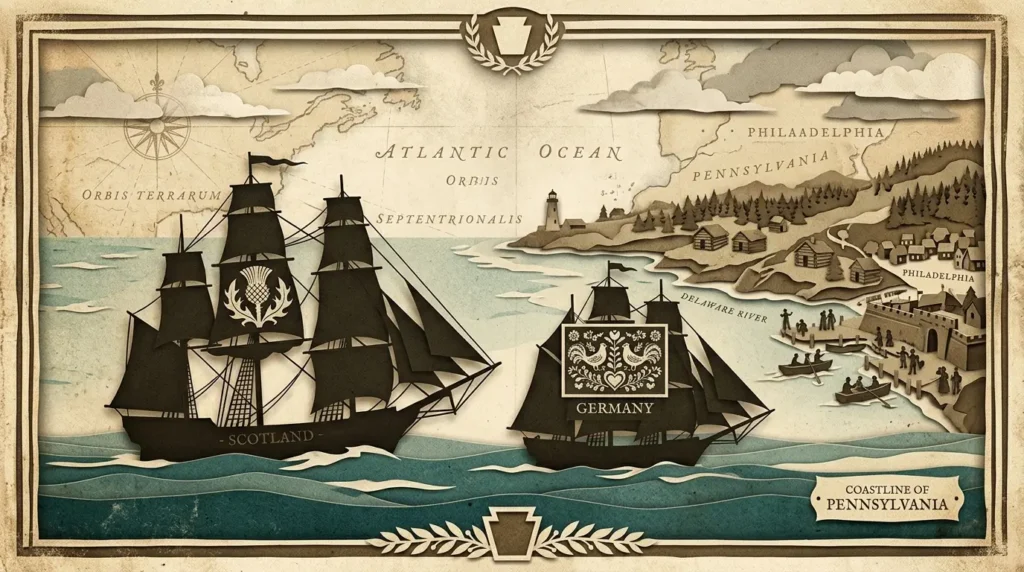
Pennsylvania slang comes mostly from the immigrant groups who settled different parts of the state Scots Irish settlers in the west, German speaking settlers in the central counties, and a mix of influences in the east tied to broader East Coast urban speech.
The exact origin of some individual words is unclear, but the historical pattern is well documented.In Western Pennsylvania, linguists trace words like “yinz” back to Scots Irish immigrants who settled the region in large numbers.
According to <cite index=”4 1″>Barbara Johnstone, a professor at Carnegie Mellon University and an expert in Pittsburghese, the Scots Irish phrase “you ones” is the likely source of “yinz.
<cite index=”26 1″>Pennsylvania Dutch is technically a dialect of German spoken by descendants of Pennsylvania Germans who largely immigrated from southern Germany, and tens of thousands of people in the state still speak it today.
History of the Term
Pennsylvania’s regional slang developed over centuries, not decades, which is part of why it varies so much by area.
The Western Pennsylvania dialect has roots going back to the 1700s, when Scots Irish and other European immigrants settled the hills around Pittsburgh.
<cite index=”8 1″>Because Pittsburgh sits on the western slope of the Allegheny Mountains, and its neighborhoods were separated by hills and rivers that discouraged social mixing, the city developed a distinct dialect even before the steel industry arrived.</cite>
“Jawn,” meanwhile, has a more recent and more debated timeline. <cite index=”14 1″>Jawn seems to have developed as a Philadelphia variant of “joint” sometime in the 1980s, following the release of a hip hop song called “That’s the Joint” by the Bronx group Funky Four Plus One.
</cite> From there, it kept “bleaching” in meaning losing its specific ties to a place or object and becoming a catch all word for almost anything.
How People Use It Today
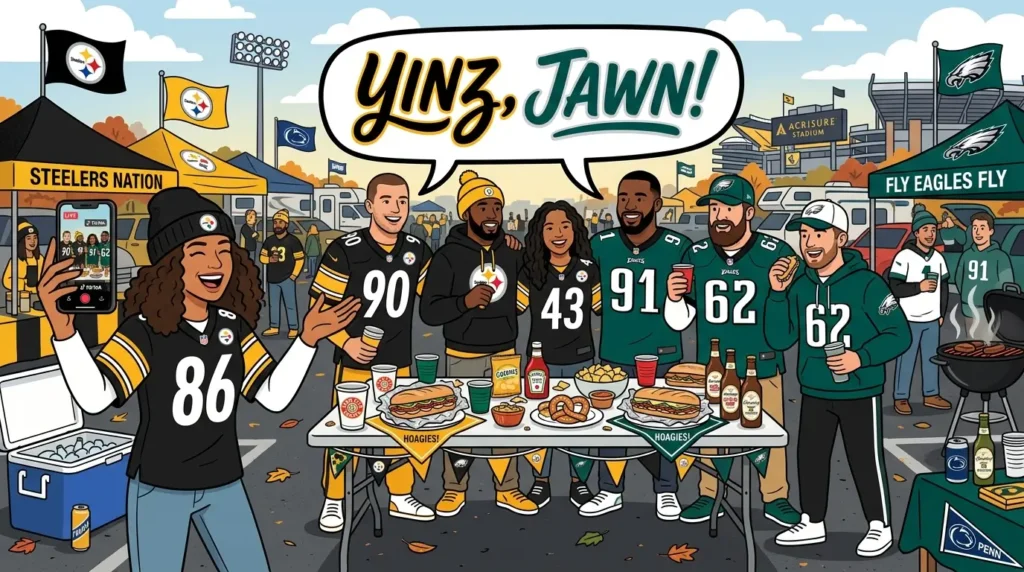
Pennsylvania slang is still very much alive, both in daily conversation and online. On TikTok and Instagram, people from Pittsburgh and Philadelphia often make videos explaining their local words to outsiders, which has actually helped spread terms like “yinz” and “jawn” far beyond the state.
On X and Reddit, threads about regional dialect differences regularly bring these words up, especially when people compare Pennsylvania to nearby states like New York, Ohio, or Maryland.
Locally, these words show up constantly in texting, casual conversation, and even branding you’ll see “yinz” and “jawn” printed on T shirts, coffee mugs, and local business signs.
Sports culture keeps a lot of this language visible too, since fans use these words while cheering on the Steelers, Eagles, Pirates, or Phillies.
Pennsylvania Slang Words and Phrases
Beyond “yinz” and “jawn,” there’s a long list of everyday Pennsylvania slang words worth knowing. “N’at” gets tacked onto the end of sentences to mean “and so on,” as in “We got pierogies, kielbasa, n’at.” “Nebby” describes someone who’s nosy.
“Gumband” is what many Western Pennsylvanians call a rubber band. “Hoagie” is the local word for a submarine sandwich, used heavily in the Philadelphia area.
What Does “Yinz” Mean in Pennsylvania Slang?
“Yinz” means “you all” and is used almost exclusively in and around Pittsburgh. <cite index=”2 1″>It’s a regional pronoun used to address two or more people, and it’s sometimes spelled “yunz” or, less commonly, “yins.
“</cite> You’ll hear it in phrases like “What do yinz want to eat?” or “Are yinz coming to the game?” People from Pittsburgh who use this dialect are often affectionately called “yinzers,” and the word has become a badge of local pride as much as an everyday pronoun.
What Is Pennsylvania Slang for “You All”?
The Pennsylvania slang word for “you all” is “yinz,” and it’s specific to Western Pennsylvania, mainly Pittsburgh.
Outside of Western PA, most Pennsylvanians won’t use “yinz” at all, so it’s a strong regional marker rather than a statewide term.
What Does “Jawn” Mean in Pennsylvania Slang?
“Jawn” is a flexible Philadelphia slang word that can stand in for almost any noun a person, place, object, or situation.
<cite index=”16 1″>It’s a placeholder word that can refer to a thing, place, person, or event, substituting for a specific word or name, and it can be used as either singular or plural.
</cite> Someone might say “Pass me that jawn” about a remote control, or “That new jawn on Broad Street” about a restaurant.
Common Pennsylvania Slang Insults
Pennsylvania has a few playful, mostly good natured insults tied to its regional dialects. In Pittsburgh, “jagoff” is the classic one used for someone being annoying, rude, or generally a jerk, especially in traffic.
“Lunch head” is another Pittsburgh area term used to mock someone acting foolish. These words are blunt but rarely meant with real hostility; locals throw them around casually, often at friends or strangers who cut them off in traffic, rather than as serious verbal attacks.
Western Pennsylvania Slang Words
Western Pennsylvania’s slang is often grouped under the nickname “Pittsburghese.” Besides “yinz,” common words include “redd up” (to clean or tidy), “gumband” (rubber band), “nebby” (nosy), “hoagie” is actually more common in the east, but “sweeper” for vacuum cleaner is distinctly Western PA.
<cite index=”31 1″>”Redd up” means to quickly clean or organize a space, especially before company arrives, and often includes running the “sweeper,” which is the local word for vacuum cleaner.</cite> “Hahs” is also a known local pronunciation of “house” in the region.
Eastern Pennsylvania Slang and Philly Phrases
Eastern Pennsylvania slang centers heavily on Philadelphia. “Jawn” is the standout word, but the region also has “wooder” for water, “hoagie” for a sub sandwich, and “jimmies” for sprinkles on ice cream.
Philly locals are also known for dropping certain consonant sounds, which shapes how words like “water” and “iron” come out.
Combined, these words create a dialect that’s distinct from both Pittsburgh’s and the rest of the East Coast’s speech patterns.
Central Pennsylvania and Pennsylvania Dutch Slang
Central Pennsylvania, especially areas like Lancaster, Berks, and Lebanon counties, carries heavy influence from Pennsylvania Dutch.
<cite index=”28 1″>This “Dutchified” English also produces phrases like “throw the cow over the fence some hay,” a sentence structure that mirrors German word order rather than standard English.</cite>
Northeast Pennsylvania Slang
Northeast Pennsylvania, including the Scranton and Wilkes Barre area, blends elements of both Eastern PA speech and its own coal region history.
Some local terms and pronunciations reflect that mining heritage, though much of the everyday slang overlaps with general Eastern Pennsylvania speech patterns rather than forming a totally separate dialect.
Weird Pennsylvania Slang You’ve Probably Never Heard
A few Pennsylvania slang terms sound completely bizarre to outsiders. “Kennywood’s open” is a Pittsburgh area phrase used to quietly tell someone their zipper is down, named after the city’s century old amusement park.
<cite index=”26 1″>”Here nah” is said at the end of a question for emphasis, similar to ending a sentence with “right?”</cite> “Jag” as a verb means to poke or annoy someone, which is where “jagoff” comes from.
Common Pennsylvania Slang Names for Local Things
Certain everyday items get their own regional names across Pennsylvania. A sub sandwich is a “hoagie” almost everywhere in the eastern half of the state. A rubber band is a “gumband” in Western PA.
A vacuum cleaner is a “sweeper” around Pittsburgh. Water fountains are sometimes called “bubblers” in small pockets influenced by nearby regions.
These small naming differences are often the first thing visitors notice, especially in restaurants and grocery stores.
Examples in Everyday Conversation
- “Yinz ready to head dahntahn for the game?”
- “Grab me that jawn off the counter, would ya?”
- “We gotta redd up before your mom gets here.”
- “I fell down by the crick and scraped my knee.”
- “That jagoff cut me off on the parkway again.”
- “Outen the lights before you go to bed.”
- “She’s real nebby about everyone’s business.”
- “Let’s get hoagies for the tailgate n’at.”
- “Watch it, the porch steps are slippy today.”
- “Kennywood’s open, by the way.”
Text Message Examples
- “yinz coming over later or nah”
- “grab that jawn from my car pls”
- “gonna redd up my room real quick”
- “meet by the crick in 10”
- “some jagoff just took my parking spot lol”
- “don’t forget to outen the lights when u leave”
- “she’s so nebby it’s actually funny”
- “hoagies on me tonight n’at”
- “steps are slippy, watch yourself”
- “lowkey miss saying yinz since I moved”
Social Media Caption Examples
- Instagram: “Yinz ready for game day? 🖤💛”
- TikTok: “POV: you say jawn and nobody outside PA knows what you mean”
- X: “explaining ‘crick’ to my out of state friends was a whole ordeal today”
- Threads: “redd up day before the holidays hits different”
- Facebook: “Throwback to Kennywood summers 🎢”
- Instagram: “hoagie run with the crew 🥪”
- TikTok: “rating Pittsburgh slang words from 1 to jagoff”
- X: “‘outen the lights’ will always be the most PA Dutch sentence ever”
- Threads: “still say sweeper instead of vacuum and I’m not sorry”
- Facebook: “n’at just means there’s more to the story lol”
Is It Positive or Negative?
Most Pennsylvania slang is neutral to positive in tone. Words like “yinz,” “jawn,” and “hoagie” are simply descriptive they’re not meant to insult anyone, and locals often use them with real pride.
Confusion is more common than offense: outsiders sometimes think words like “jawn” sound rude or dismissive simply because they don’t know the context, when in reality it’s just a filler word for almost anything.
Who Uses This Slang?
Pennsylvania slang spans generations, but usage patterns differ by age and region. Older, lifelong residents tend to use the fuller dialect naturally, including grammar patterns like “needs washed” instead of “needs to be washed.
” Younger people often use a lighter version, picking specific words like “yinz” or “jawn” for identity and humor rather than using the full accent.
Sports fans, service industry workers, and people in blue collar communities tend to use this slang the most consistently, while it shows up less in formal or professional settings.
Similar Slang Words
| Slang | Meaning |
| Y’all (Southern US) | You all |
| Youse (NY/NJ) | You all |
| Joint (general slang) | A place or thing, related to “jawn” |
| Crick (Midwest/Appalachia) | Regional pronunciation of creek |
| Wicked (New England) | Very, used as an intensifier |
Opposite Words
There isn’t a true “opposite” of most Pennsylvania slang, since these are regional identity words rather than words with clear antonyms.
The closest contrast would be standard, formal English equivalents: “you all” instead of “yinz,” “clean up” instead of “redd up,” and “creek” instead of “crick.
” These standard versions carry a more neutral, less regionally specific tone.
Common Mistakes
A common mistake is assuming all Pennsylvania slang is the same across the whole state it’s not, and mixing up Pittsburgh terms with Philadelphia terms will confuse locals fast.
Another mistake is misspelling “yinz” as “yins” in writing, which, while sometimes used in speech, isn’t the standard spelling. People also often assume “jawn” always means “thing,” when it can just as easily mean a person or a place depending on context.
When NOT to Use It
Pennsylvania slang isn’t a good fit for professional emails, job interviews, formal presentations, or academic writing. Words like “yinz,” “jawn,” and “n’at” read as very casual, and using them in a business context can come across as unpolished, even if that’s not the intent.
School essays and resumes should also stick to standard English. Save the regional slang for texting, casual conversation, and social posts where the informal tone actually fits.
Fun Facts
- <cite index=”9 1″>People from Pittsburgh sometimes replace the “t” sound in words like “better” and “brother” with a “d” sound or a glottal stop.</cite>
- <cite index=”7 1″>”Yinzer” pride grew stronger in the 21st century as Pittsburgh became known as a hub for urban revitalization.</cite>
- <cite index=”18 1″>Dictionary.com officially added “jawn” to its list of recognized slang terms, describing it as “chiefly Philadelphia.”</cite>
- <cite index=”28 1″>Pennsylvania Dutch is spoken by over 300,000 people, with the highest concentration in Berks, Lancaster, Lebanon, and Lehigh counties.</cite>
- <cite index=”15 1″>Linguists call the process behind “jawn” becoming so flexible “semantic bleaching,” where a word loses its narrow meaning and becomes broadly applicable.</cite>
Frequently Asked Questions
1:Why do Pennsylvanians say crick?
“Crick” is a regional pronunciation of “creek” rooted in dialect history rather than a mistake. It’s especially common in rural parts of Pennsylvania, along with nearby states like West Virginia and Kentucky.
Some Pennsylvanians even use “crick” and “creek” to mean slightly different things a “crick” as a smaller, shallow trickle of water, and a “creek” as a larger stream.
The vowel shift behind “crick” developed among early Scots Irish and German settlers in the Midland dialect region and spread from there through families and communities over generations.
2:What are some Philly phrases?
Beyond “jawn,” Philadelphia has plenty of its own local phrases. “Wooder ice” refers to a frozen dessert similar to Italian ice.
“Down the shore” means heading to the Jersey Shore for a vacation, a phrase used constantly by Philly area residents. “Jimmies” are chocolate or rainbow sprinkles on ice cream.
Locals also drop certain sounds in casual speech, making “water” sound closer to “wooder.” These phrases are tied closely to Philadelphia’s food culture and East Coast identity.
3:What does PA slang for?
“PA” itself isn’t slang it’s simply the standard postal abbreviation for Pennsylvania. But within Pennsylvania slang, plenty of abbreviations and shortened words exist, like “dahntahn” for downtown in the Pittsburgh dialect.
If someone says “PA slang,” they usually mean the broader collection of regional words tied to the state, not a specific term that “PA” stands in for.
4:What is Pennsylvania’s state saying?
Pennsylvania doesn’t have one official state saying, but “yinz” is the phrase most commonly associated with the state in pop culture, largely because of its strong ties to Pittsburgh identity. Philadelphia’s “jawn” is a close second in terms of recognition outside the state.
Neither is an official motto Pennsylvania’s actual state motto is “Virtue, Liberty and Independence” but “yinz” and “jawn” are the words most people associate with Pennsylvania speech.
5:Is there a Pennsylvania slang quiz to test your knowledge?
There’s no single official quiz, but plenty of local news sites and fan pages create informal ones to test how well people know Pittsburgh or Philadelphia slang.
These quizzes usually cover words like “yinz,” “jawn,” “hoagie,” and “redd up,” asking readers to match the word to its meaning.
They’re a fun, low stakes way to see how much regional dialect knowledge someone actually has, especially for transplants trying to fit in.
Final Thoughts
Pennsylvania slang isn’t one dialect it’s a handful of them, shaped by different waves of immigrants settling different corners of the state.
None of this language is going anywhere soon. If anything, social media has given these words new life, letting people from Pittsburgh and Philadelphia show off their local identity to a much wider audience.
If you’re planning a move to the state, visiting for a game, or just curious after hearing a coworker say something confusing, knowing these words makes Pennsylvania feel a lot less like a foreign language and a lot more like home.

Chloe Mitchell is passionate about digital communication and the stories behind viral words. She writes for SlangGuide.com, helping readers discover the meanings, origins, and everyday use of popular slang terms.